
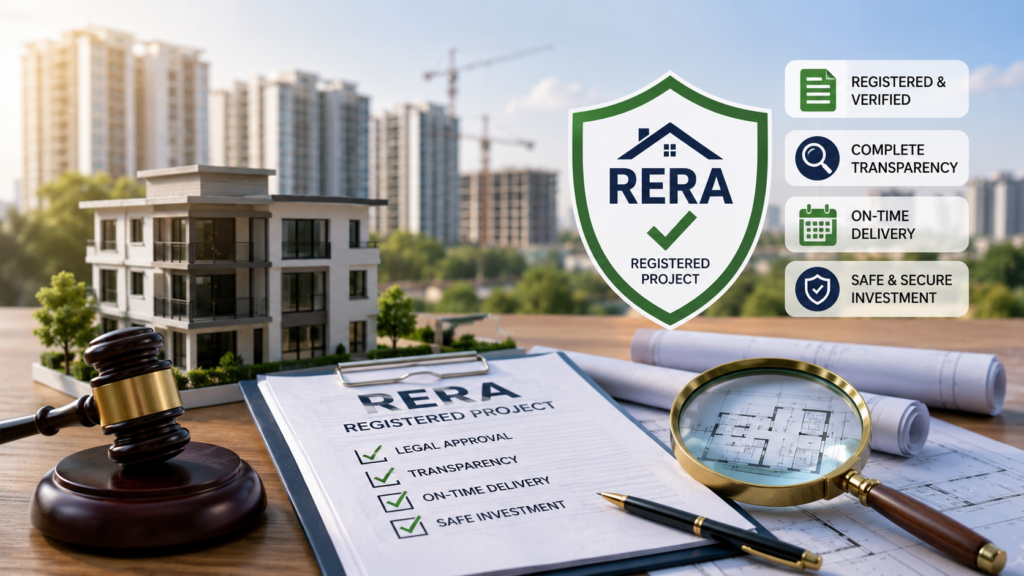
Buying a home is one of the biggest financial decisions you can make. Whether you are planning to purchase a luxury apartment, builder floor, residential plot, or commercial property, checking the project’s RERA registration should be one of your first steps.
The Real Estate (Regulation and Development) Act, commonly known as RERA, was introduced to improve transparency and accountability in the real estate sector and strengthen homebuyer protections. Most qualifying real estate projects are required to register with the relevant state RERA authority before being marketed or sold.
A RERA registration number alone, however, should not be treated as a complete quality certificate. Buyers should use the official RERA portal to verify the project’s registration status, promoter information, declared completion date, approvals, plans and other available records.
What Is RERA?
RERA stands for Real Estate (Regulation and Development) Act, . It was created to bring greater transparency into real estate transactions and provide a regulatory framework for homebuyers, developers and real estate agents.
Each state or union territory has its own regulatory authority and online portal. Buyers can generally search registered projects using details such as the project name, promoter name or RERA registration number.
For qualifying projects, registration requirements generally cover projects above the statutory thresholds, including projects exceeding 500 square metres or involving more than eight apartments, subject to the Act and applicable state rules and exemptions.
Why Should You Check RERA Before Buying Property?
A property purchase involves a significant amount of money. A simple RERA verification can help you compare the information provided by a developer or salesperson with information available on the regulator’s portal.
1. Verify Project Registration
The first thing to check is whether the project is registered with the appropriate state RERA authority.
Search the official portal using:
- Project name
- Developer or promoter name
- RERA registration number
- Location, where available
Make sure the project name and promoter details match the information given to you by the salesperson.
2. Check the RERA Registration Status
Do not stop after finding a RERA number.
Check whether the project is currently shown as active, extended, completed, lapsed or otherwise marked by the authority. The exact terminology can vary by state.
The status can give you important context before making a booking decision.
3. Compare the Possession Date
One of the most important details to verify is the project’s declared completion or possession timeline.
Compare the date available on the RERA record with:
- The date mentioned in advertisements
- The date mentioned by the salesperson
- The date mentioned in your booking documents
- The possession timeline in the agreement for sale
If different dates are being quoted, ask the developer to explain the difference before making a payment.
4. Check the Promoter Details
Verify the developer’s legal or promoter details listed on the RERA portal.
Look for information such as:
- Promoter name
- Registered address
- Project details
- Previous registered projects, where available
- Contact information
- Other disclosures available on the portal
This helps you ensure that you are dealing with the same entity mentioned in the project’s official documentation.
What Documents Should You Check on the RERA Portal?
Depending on the state portal and project, you may find several important documents and disclosures.
Before booking, look for:
- Approved or sanctioned plans
- Project layout
- Building details
- Project specifications
- Promoter information
- Declared completion date
- Construction progress
- Uploaded approvals
- Financial or project-related disclosures
- Quarterly or periodic updates
- Details of complaints or orders, where available
Not every portal displays information in exactly the same format, so buyers should review the actual project record rather than relying only on a brochure or sales presentation.
How to Check RERA Registration Online: Step-by-Step Guide
Step 1: Find Your State RERA Website
First, identify the RERA authority for the state where the property is located.
For example, a property in Gurugram would require checking the relevant Haryana RERA authority rather than another state’s portal.
Step 2: Search for the Project
Use the project’s exact name or the RERA registration number provided by the developer.
If possible, search using more than one detail to make sure you have found the correct project.
Step 3: Match the Developer Name
Check whether the promoter name on the portal matches the legal entity mentioned in the project’s documents.
This is particularly important where a project is marketed under a brand name that differs from the developer’s legal company name.
Step 4: Review Project Details
Once you find the project, carefully review:
- Project location
- Land details
- Number and type of units
- Project configuration
- Approved plans
- Amenities
- Construction status
- Declared completion date
Step 5: Compare the RERA Information With the Sales Material
This is a very important step.
Do not rely only on verbal promises. Compare information from the RERA record with:
- Brochure
- Price list
- Payment plan
- Application form
- Agreement for sale
- Floor plan
- Carpet area
- Possession commitment
Any major difference should be clarified before signing or paying.
Check RERA Carpet Area Carefully
Property advertisements may use terms such as super area, saleable area or built-up area.
However, buyers should carefully examine the RERA carpet area and understand exactly what they are purchasing.
Ask the developer to provide a clear area statement showing the relevant measurements.
Do not compare properties solely on the basis of a large super area figure. Compare the actual usable space, configuration, specifications and total cost.
Check the Project’s Construction Progress
For an under-construction property, the project’s current construction status is extremely important.
Check whether the RERA portal provides periodic updates. Compare the reported progress with what you see during a site visit.
For example, if the project record indicates substantial construction progress but the physical site appears significantly behind, ask the developer for clarification.
Check Complaints and Orders
Some RERA portals provide information about complaints, cases or orders involving a project or promoter.
Where such information is available, review it before booking.
You should pay particular attention to repeated issues involving:
- Delayed possession
- Refund disputes
- Construction quality
- Agreement-related disputes
- Non-compliance
- Project extensions
A complaint does not automatically mean that a project is unsuitable. However, repeated or serious issues deserve careful investigation.
RERA Check for Builder Floors
If you are considering a builder floor in Gurgaon or Gurugram, do not assume that every property needs to be checked in exactly the same way as a large apartment project.
The applicability of RERA can depend on the nature, size and circumstances of the project and applicable state rules.
For a builder floor, buyers should also investigate other important legal and property documents, including title documents, sanctioned building plans, approvals, ownership structure and applicable completion or occupancy documentation.
RERA verification should therefore be considered one part of a broader property due-diligence process.
Common Mistakes Buyers Make During RERA Verification
Mistake 1: Checking Only the RERA Number
Finding a registration number is not enough.
Always open the actual project record and review the information available there.
Mistake 2: Trusting Only the Salesperson
Sales representatives can provide useful information, but buyers should independently verify important facts through official records.
Mistake 3: Ignoring the Possession Timeline
Always compare the declared RERA timeline with the possession commitment in your agreement.
Mistake 4: Not Checking Project Updates
For an under-construction project, periodic progress information can be valuable when assessing the project’s current position.
Mistake 5: Ignoring Other Legal Documents
RERA registration does not replace independent verification of title, approvals, encumbrances, construction permissions, or other property-specific legal requirements.
RERA Check vs Complete Property Due Diligence
RERA verification is important, but it should not be the only step before buying.
A smart homebuyer should consider checking:
- RERA registration
- Developer/promoter details
- Project approvals
- Land title
- Encumbrances
- Approved building plans
- Carpet area
- Possession timeline
- Agreement for sale
- Payment schedule
- Occupancy/completion documents for ready properties
- Construction quality
- Maintenance charges
- Location and connectivity
- Independent legal verification
For a high-value purchase, consulting a qualified property lawyer before signing the agreement can be worthwhile.
RERA Check Guide for Gurgaon Property Buyers
If you are buying properties in Gurgaon/Gurugram, RERA verification can be especially useful when comparing apartments, new residential projects, commercial developments and other qualifying projects.
Before paying a booking amount, verify:
- RERA registration
- Promoter details
- Project status
- Declared possession date
- Project configuration
- Carpet area
- Construction progress
- Available approvals
- Complaints/orders, if shown
- Agreement terms
Do not make a decision only because a project is marketed as “RERA approved.” Use the official record to verify the actual information.
Final RERA Check Checklist
Before booking your property, keep this quick checklist handy:
☐ Find the official state RERA portal
☐ Search the project
☐ Verify the RERA registration number
☐ Match promoter/developer details
☐ Check registration status
☐ Review possession/completion timeline
☐ Check project configuration
☐ Verify RERA carpet area
☐ Review approved plans and documents
☐ Check construction updates
☐ Review complaints/orders where available
☐ Compare RERA data with the brochure
☐ Check the agreement for sale
☐ Verify title and other legal documents
☐ Consider independent legal advice
Conclusion
A RERA check is one of the most useful first steps before buying property in India. It can help buyers verify important project information and identify inconsistencies between marketing claims and regulatory records.
However, RERA registration should not be viewed as the only measure of whether a property is a good investment. Buyers should combine RERA verification with title checks, approval verification, agreement review, construction inspection and independent legal due diligence.
Taking a little extra time before booking can help you make a more informed and confident property-buying decision.
FAQs About RERA Check
1. What is a RERA check?
A RERA check means verifying a real estate project’s registration and publicly available project information through the relevant state or union territory RERA authority.
2. How can I check RERA registration online?
Visit the official RERA portal for the state where the property is located and search using the project name, promoter name or RERA registration number.
3. Is RERA registration enough before buying a property?
No. RERA verification is important, but buyers should also independently check title, approvals, agreements, encumbrances, construction status and other relevant legal documents.
4. What should I check on a RERA project page?
Check the registration status, promoter details, project location, declared completion date, carpet area, approved plans, construction progress and other documents or disclosures available on the official portal.
5. Should I check RERA before buying a builder floor?
You should determine whether the builder-floor project falls within RERA’s applicability and also carry out broader legal due diligence. Check title, sanctioned plans, approvals, ownership documents and applicable completion/occupancy documentation before purchasing.